

Spot Check is unreliable, disruptive, and time consuming
- Collecting vitals manually only every 4-6 hours can leave patients unmonitored 96% of the time1
- Manual respiratory rate (RR) measurements for hospital patients are frequently inaccurate, often due to estimation and value bias (notably clustering at 18 or 20 breaths per minute)2,3
- Routine vitals are a top “sleep interrupter.” In a 2024 multi-center study, 33% of all patient sleep interruptions were due to routine vital-sign checks.4

Telemetry is expensive, uncomfortable, and resource-intensive
- Telemetry monitoring is expensive for hospitals (costing up to $1,400 per pt./day)5
- Telemetry can be uncomfortable for patients, often associated with perceived physical and psychological limitations6
- A retrospective review found that 22.3% of patients were inappropriately assigned telemetry at admission, and over half remained monitored longer than guidelines recommend7
- Overuse of telemetry leads to unnecessary alarms8
The Case for Continuous Monitoring
Clear and Proven Benefits

Reduced Burnout, Empowered Clinicians
- Decreased time spent manually documenting9
- Reduced threshold alarms and alarm fatigue10
- Allows for more bedside time with patients

Patient Safety
- Earlier deterioration detection and faster intervention11
- Fewer unplanned ICU admits2 & rapid-response calls12, 13
- Lower complication5 & mortality rates14, 15

Operational and Throughput Efficiency
- Shorter length of stay11
- More telemetry bed capacity becomes available when continuous monitoring is an alternative
- Increase in telemetry bed availability can result in a decrease in ED boarding times

Improved Patient Satisfaction
- Minimize nighttime spot-checks17
- Wire-free mobility for easy ambulation
Continuous Monitoring With BioButton
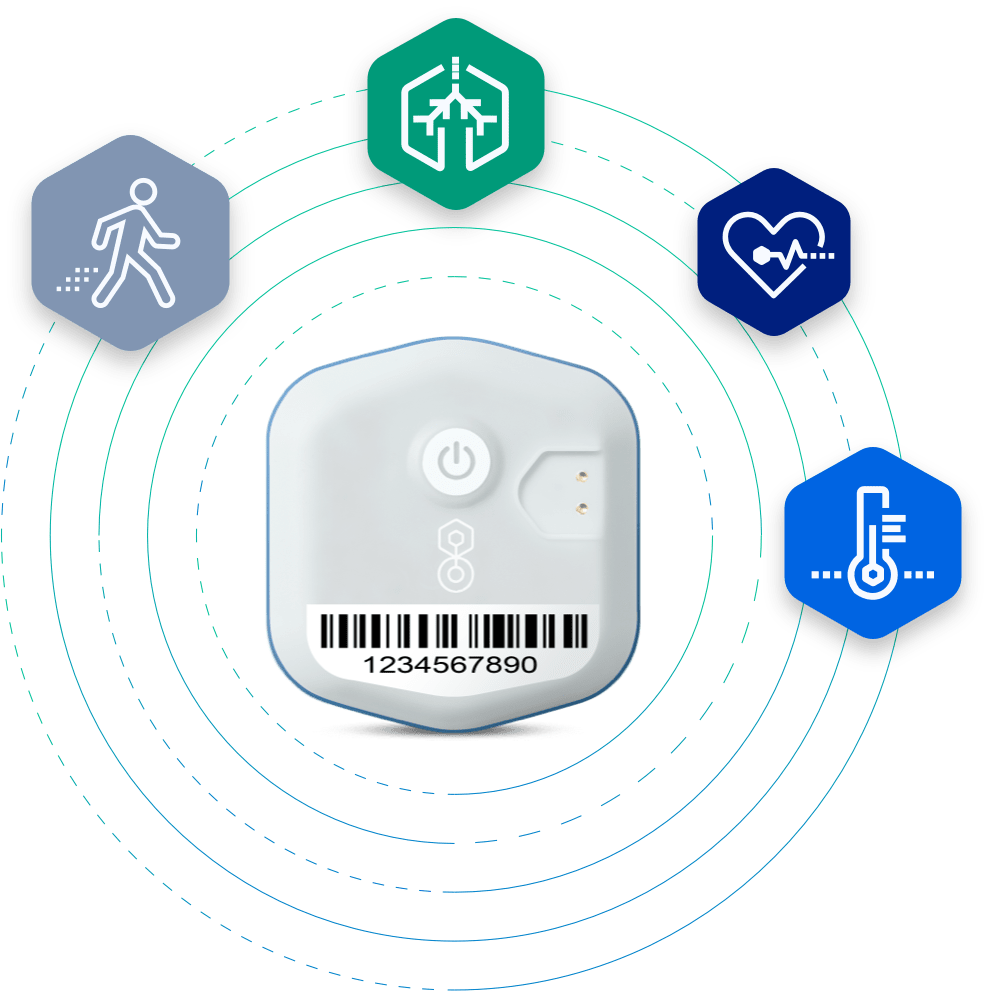
Large scale (400,000+ patients as of October 2025) implementations have shown that the BioButton solution:
- Provides continuous monitoring of vital signs with high clinical accuracy
- Provides early detection of patient deterioration, with notifications occurring on average 14.8 hours in advance of a deterioration event
- Is associated with a 7.7-hour reduction in length of stay11
- Reduces time spent taking manual vitals: by 50%, from 420 to 210 minutes per day
Featured Publications
- Weinger MB, Lee LA. No patient shall be harmed by opioid-induced respiratory depression. APSF Newsletter. 2011;26(2):21 https://www.apsf.org/article/no-patient-shall-be-harmed-by-opioid-induced-respiratory-depression/
- Semler MW et al. Flash mob research: a single-day, multicenter, resident-directed study of respiratory rate. Chest. 2013 Jun;143(6):1740-1744. https://journal.chestnet.org/article/S0012-3692(13)60406-7/abstract
- Badawy J, Nguyen OK, Clark C, Halm EA, Makam AN. Is Everyone Really Breathing 20 Times a Minute? Assessing Epidemiology and Variation in Recorded Respiratory Rate in Hospitalized Adults. BMJ Quality & Safety. 2017;26(10):832-836. https://pubmed.ncbi.nlm.nih.gov/28652259/
- Koshy K, Gibney M, O’Driscoll DM, Ogeil RP, Young AC. Factors affecting sleep quality in hospitalised patients. Sleep Breath. 2024 Dec;28(6):2737-2740. https://link.springer.com/article/10.1007/s11325-024-03144-8
- Knees M, Mastalerz K, Simonetti J, Berry A. Decreasing inappropriate telemetry use via nursing-driven checklist and Electronic Health Record order set. Cureus. 2022 Sep 10;14(9):e28999. https://pubmed.ncbi.nlm.nih.gov/36249623/
- Holm MS, Fålun N, Bendz B, Fridlund B, Langørgen J, Pettersen TR, Sandau KE, Norekvål TM. The patient experience of in-hospital telemetry monitoring: a qualitative analysis. Eur J Cardiovasc Nurs. 2024 Apr 12;23(3):258-266. https://academic.oup.com/eurjcn/article/23/3/258/7244653
- Chaudhary R, Kingsley T, Sarkar S, et al. Telemetry: Appropriateness of Initial Assignment and Duration in Nonintensive Setting. The American Journal of Managed Care. 2020;26(11):459-460. https://www.ajmc.com/view/telemetry-appropriateness-of-initial-assignment-and-duration-in-nonintensive-setting
- Srinivasa E, Mankoo J, Kerr C. An evidence‐based approach to reducing cardiac telemetry alarm fatigue. Worldviews on Evid Based Nurs. 2017;14(4):265–273. https://pubmed.ncbi.nlm.nih.gov/28432853/
- Sigvardt E, Grønbaek KK, Jepsen ML, Søgaard M, Haahr L, Inácio A, Aasvang EK, Meyhoff CS. Workload associated with manual assessment of vital signs as compared with continuous wireless monitoring. Acta Anaesthesiol Scand. 2024 Feb;68(2):274-279. https://onlinelibrary.wiley.com/doi/10.1111/aas.14333
- Brown H, Terrence J, Vasquez P, Bates DW, Zimlichman E. Continuous monitoring in an inpatient medical-surgical unit: a controlled clinical trial. Am J Med. 2014 Mar;127(3):226-32. https://www.amjmed.com/article/S0002-9343(13)01072-3/abstract
- Weller, G.B.; Mault, J.; Ventura, M.E.; Adams, J.; Campbell, F.J.; Tremper, K.K. A retrospective observational study of continuous wireless vital sign monitoring via a medical grade wearable device on hospitalized floor patients. J. Clin. Med. 2024, 13, 4747. https://www.mdpi.com/2077-0383/13/16/4747
- Eddahchouri Y, Peelen RV, Koeneman M, Touw HRW, van Goor H, Bredie SJH. Effect of continuous wireless vital sign monitoring on unplanned ICU admissions and rapid response team calls: a before-and-after study. Br J Anaesth. 2022 May;128(5):857-863. https://www.bjanaesthesia.org/article/S0007-0912(22)00073-3/fulltext
- Weller RS, Foard KL, Harwood TN. Evaluation of a wireless, portable, wearable multi-parameter vital signs monitor in hospitalized neurological and neurosurgical patients. J Clin Monit Comput. 2018;32(5):945–951. https://link.springer.com/article/10.1007/s10877-017-0085-0
- Verrillo SC, Cvach M, Hudson KW, Winters BD. Using continuous vital sign monitoring to detect early deterioration in adult postoperative inpatients. J Nurs Care Qual. 2019;34(2):107–113. https://journals.lww.com/jncqjournal/abstract/2019/04000/using_continuous_vital_sign_monitoring_to_detect.4.aspx
- Pearse RM, Moreno RP, Bauer P, Pelosi P, Metnitz P, Spies C et al. Mortality after surgery in Europe: a 7 day cohort study. Lancet. 2012; 380: 1059–65. https://www.thelancet.com/journals/lancet/article/PIIS0140-6736(12)61148-9/fulltext
- Yoder JC, Yuen TC, Churpek MM, Arora VM, Edelson DP. A prospective study of nighttime vital sign monitoring frequency and risk of clinical deterioration. JAMA Intern Med. 2013 Sep 9;173(16):1554-5. https://pmc.ncbi.nlm.nih.gov/articles/PMC3773251/
- Najafi N, Robinson A, Pletcher MJ, Patel S. Effectiveness of an Analytics-Based Intervention for Reducing Sleep Interruption in Hospitalized Patients: A Randomized Clinical Trial. JAMA Intern Med. 2022;182(2):172–177. https://jamanetwork.com/journals/jamainternalmedicine/fullarticle/2787642