
Core Technology
The BioButton wearable device continuous monitoring solution is designed for proactive patient monitoring, collecting and analyzing the leading indicators of patient decline.

BioButton Wearable
Continuous vital sign and biometric measurements of patients both in facilities and at home

Flexible Gateways
Patient-facing BioMobile app, BioHub Cellular gateway, or BioHub Wi-Fi gateway

BioDashboard Analysis
and Display
Exception management software to monitor patients in-hospital and/or home
Smarter Monitoring. Better Outcomes.

Source: Churpek MM, Adhikari R, Edelson DP. The value of vital sign trends for detecting clinical deterioration on the wards. Resuscitation. 2016;102:1–5. doi:10.1016/j.resuscitation.2016.02.005
Improve Patient Safety
Studies show that comprehensive monitoring compared with standard, intermittent vitals reduce:
- Unplanned ICU admissions1-3
- Rapid response team activations1,3,4
- Average length of hospital stay5
Drive Operational Efficiency
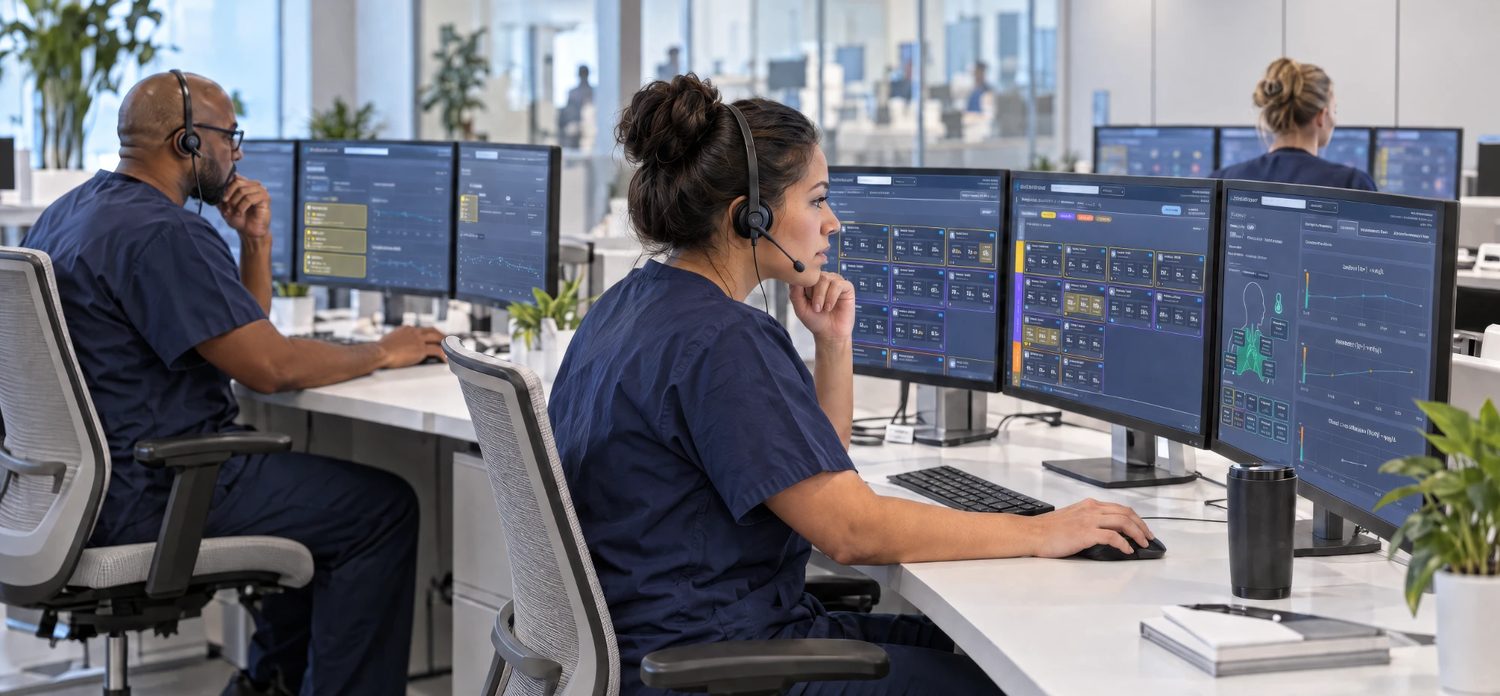
With BioButton continuous monitoring data, patient stability insights can be leveraged to advance key hospital initiatives:
- Length of stay reduction efforts5,7
- Virtual rounding optimization7
- Telemetry overuse reduction programs

Increase Patient and Nurse Satisfaction
With BioButton monitoring workflows in place, organizations can choose to alter their manual vital sign frequency6,7. This can have the benefits of:
- Minimizing nighttime spot checks, improving patient restfulness6,7
- Focusing nurse and staff attention on patients who most need care7

The new standard in proactive monitoring for post-acute care
With the ability to transition monitoring seamlessly into the home, BioButton makes transitional care programs more convenient and connected for patients, while also:
- Enhancing facility length of stay reduction programs5,7
- Preventing readmissions8,9
- Supporting RPM reimbursement
Interested in trying the BioButton?
We have demo opportunities to better understand our monitoring solution for your patients.
Recent News
Solving for Telemetry Overuse in Patient Monitoring with BioIntelliSense
Current challenges in patient monitoring Telemetry has become a standard tool in hospitals for monitoring patients who require continuous ECG monitoring, but evidence shows it’s widely overused. Up to 43%…
Read more
Earlier Detection, Better Outcomes: Houston Methodist ICU Transfer Results with BioButton
New research from Houston Methodist published in the Journal of Clinical Medicine reveals the life-saving potential of continuous patient monitoring at scale. Houston Methodist studied 1,120 high-risk patients undergoing transfer…
Read more
BioIntelliSense Announces Observational Study in Journal of Clinical Medicine
The large-scale study of nearly 12,000 hospitalized patients highlights continuous multiparameter vital sign monitoring resulted in significant positive impact on patient outcomes BioIntelliSense, a continuous health monitoring and clinical intelligence…
Read moreReferences
- Eddahchouri, Yassin, et al. “Effect of Continuous Wireless Vital Sign Monitoring on Unplanned ICU Admissions and Rapid Response Team Calls: A Before-and-After Study.” British Journal of Anaesthesia, vol. 128, no. 5, 2022, pp. 857–863. https://doi.org/10.1016/j.bja.2022.01.036.
- Verrillo, Stephanie C., et al. “Using Continuous Vital Sign Monitoring to Detect Early Deterioration in Adult Postoperative Inpatients.” Journal of Nursing Care Quality, vol. 34, no. 2, 2019, pp. 107–113. https://pubmed.ncbi.nlm.nih.gov/30095509/.
- Weller, Robert S., Kristina L. Foard, and Timothy N. Harwood. “Evaluation of a Wireless, Portable, Wearable Multiparameter Vital Signs Monitor in Hospitalized Neurological and Neurosurgical Patients.” Journal of Clinical Monitoring and Computing, vol. 32, no. 5, 2018, pp. 945–951. https://doi.org/10.1007/s10877-017-0085-0.
- Stellpflug, Courtney, et al. “Continuous Physiological Monitoring Improves Patient Outcomes.” American Journal of Nursing, vol. 121, no. 4, 2021, pp. 40–46. https://doi.org/10.1097/01.NAJ.0000742504.44428.c9.
- Sun, Lei, et al. “Clinical Impact of Multiparameter Continuous Non-Invasive Monitoring in Hospital Wards: A Systematic Review and Meta-Analysis.” Journal of the Royal Society of Medicine, vol. 113, no. 6, 2020, pp. 217–224. https://pubmed.ncbi.nlm.nih.gov/32498718/.
- “Houston Methodist Hospital Internal Analysis. Reduction Realized with Adoption of a New Vitals Collection Protocol in Jan 2024; Vitals Collection Requirement Reduced from Q4 to Q6 for Patients with a BioButton.”
- Weller, Geoffrey B., et al. “A Retrospective Observational Study of Continuous Wireless Vital Sign Monitoring via a Medical Grade Wearable Device on Hospitalized Floor Patients.” Journal of Clinical Medicine, vol. 13, no. 16, 2024, article 4747. https://doi.org/10.3390/jcm13164747.
- “American Health Network Analysis. Thirty-Day Readmission Rate Analysis of Medicare Advantage Patients Discharged from American Health Network, 2023.”
- “Earlier Activation of Clinical Emergency Response Team (CERT) After Implementing Vital Sign Remote Patient Monitoring: Mortality Impact on Those Transferred to ICU.” Jan. 2025. https://www.researchgate.net/publication/388385774_Earlier_Activation_of_Clinical_Emergency_Response_Team_CERT_After_Implementing_Vital_Sign_Remote_Patient_Monitoring .